(Image source from: REUTERS)
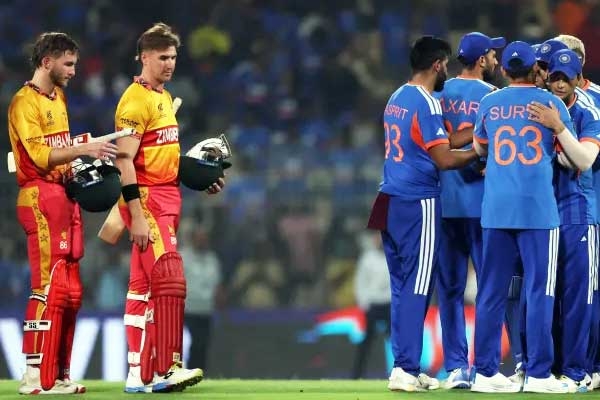
India secured a spot for a knockout match against the West Indies on Sunday by defeating Zimbabwe easily. On this night, Abhishek Sharma achieved his first fifty in a World Cup, and India made a slight adjustment to their batting lineup, reaching the second-highest score ever in T20 World Cups, surpassing the 254 runs Zimbabwe gave away in their previous game. Six players batted for India, with each batting between 15 and 30 balls, showing strike rates ranging from 158.33 to 275. They smashed 17 sixes, the highest number hit by India in a single T20 World Cup game. Zimbabwe chose to have India bat first, hoping it would benefit their fast bowlers. Their assessment of the situation was correct, but the experienced Indian bowlers performed much better, limiting Zimbabwe to just 33 runs in the first five overs, making it tough for them to recover. Now eliminated from the tournament, Zimbabwe dropped two critical catches, raising their total to five in the Super Eight across two matches, after only missing one during the first round. Brian Bennett's unbeaten 97 was their only bright spot.
India recognized that having three left-handed batters at the top was allowing off-spinners the chance to take advantage, decided not to promote Suryakumar Yadav to number three, and sacrificed some lower-order hitting by Rinku Singh to include Sanju Samson. Zimbabwe, hoping to start with their tall fast bowlers, immediately faced Samson, who hit them for sixes down the ground from the back foot in the first couple of overs. He eventually got out for 24 off 15 balls, but was part of India's largest opening partnership of this tournament, scoring 48 runs off 3.4 overs. Unlike in previous games, Abhishek didn’t aggressively attack the fast bowlers or expose his stumps. He made a wonderful inside-out shot over extra cover for four runs on his third ball, which was also a no-ball, and then sent the free hit for another four. Abhishek reached 33 runs off 13 balls during the powerplay as Zimbabwe chose to avoid using spin before the field spread out.
As the powerplay came to a close, Sikandar Raza and Bennett bowled two overs without allowing Abhishek and Ishan Kishan to score any boundaries. Both players remained calm, with Ishan utilizing his power and Abhishek using footwork to overcome the challenge. It only took 26 balls for Abhishek to achieve his first World Cup fifty, which turned out to be the second-slowest of his 11 scores of fifty or more in T20Is. If Zimbabwe had caught two fairly simple chances, Kishan would have been out for 26 off 19 balls and Suryakumar for eight off four. Instead, they ended with scores of 38 off 24 and 33 off 13, setting up a great situation for Hardik Pandya and Tilak Varma to finish the innings. Hardik and Tilak added an unbroken 84 runs in just 31 balls, each hitting four sixes while almost competing against one another. Hardik was the only one to reach fifty, but he had already scored 12 runs when Tilak came to bat. Tilak was quicker off the mark, hitting well from his first ball, utilizing space effectively both in front and behind the wicket. Hardik primarily relied on power to hit down the ground and surpassed Tilak with two sixes on the last two balls of the innings.
Arshdeep Singh only allowed one boundary in his initial two overs, while Hardik took advantage of noticeable seam movement with the new ball. With Zimbabwe at 25 for no loss after four overs, they needed to maintain a scoring rate of 14.5 runs per over to stay in the tournament. Axar Patel, who had missed the last match due to a lineup of left-handed batsmen, took just two balls to claim a wicket, dismissing left-hander Tadiwanashe Marumani. Varun Chakravarthy took his ninth wicket by getting rid of Dion Myers, continuing his streak of taking at least one wicket in every T20I.
In the end, India won comfortably by 72 runs, but they might be concerned about Varun conceding 35 runs and allowing three sixes, as well as their sixth bowler Shivam Dube’s poor performance, giving away 46 runs in two overs. Thanks to South Africa’s earlier victory over West Indies, India did not feel the pressure to win by a large margin, allowing them to try out different strategies than they normally would. Zimbabwe managed to score 184 runs largely because of Bennett, who demonstrated that he could play at a higher level after originally scoring in the 130s without hitting a single six. In this match, he hit six sixes and posted a strike rate of 164.4. As the hundred approached, Arshdeep dismissed three batsmen in two overs, which meant Bennett had limited opportunities at the end. Arshdeep also surpassed Jasprit Bumrah as India’s leading wicket-taker in T20 World Cups.